
Tennis Court Construction in Johannesburg: From Ground Preparation to a Finished Sports Court
Tennis Court Construction Johannesburg is an important service for schools, sports facilities and recreational spaces looking to build quality outdoor courts. From ground preparation to the finished playing surface, every stage contributes to creating a suitable sports facility.
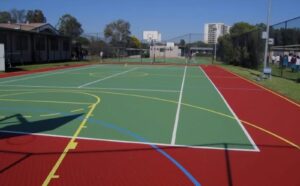
At Summit Asphalt & Paving, we understand the importance of combining practical construction work with a quality finish. For example, one of our sports court projects involved constructing a new outdoor court at a school facility in Johannesburg, Gauteng. Built from the ground up, the completed court features green and red surface sections with clearly defined playing lines. In this project overview, we explore the key stages involved in sports court construction, from preparing the ground to completing the finished playing surface.
Tennis Court Construction: Building from the Ground Up
Constructing a new tennis court involves much more than applying coloured coatings and painting the lines. Instead, each stage must be considered carefully to support the quality, usability and appearance of the finished facility.
For this Johannesburg project, the objective was to create a dedicated outdoor sports court from scratch. As a result, the work involved several important construction considerations, including site preparation, the playing-surface base and the final court markings.
1. Ground Preparation and Site Readiness
First, the construction process begins with preparing the site. This is one of the most important stages because the condition of the ground influences the work that follows.
Depending on the site conditions and project specification, ground preparation may involve clearing the area, preparing and levelling the ground, and establishing the required levels and gradients.
In addition, drainage and water runoff must be considered during the planning stage. Without suitable drainage, water may accumulate on the playing surface and contribute to deterioration over time.
Therefore, proper site preparation helps establish a suitable foundation for the subsequent construction stages.
2. Preparing the Court Foundation and Surface
Once the ground is ready, the next stage involves constructing the foundation and preparing the playing-surface base according to the project specification.
The base must provide appropriate support for the selected sports-surfacing system. For this reason, the construction method should account for the ground conditions, intended use of the court and requirements of the chosen materials.
Furthermore, surface levels and drainage require careful attention, particularly for outdoor sports facilities exposed to changing weather conditions.
A properly prepared base helps provide a suitable foundation for the finishing treatments and court markings. Consequently, this stage plays an important role in the overall construction process.
3. Applying the Coloured Sports Court Finish
After the foundation and playing surface have been prepared, attention turns to the court’s finish.
For this Johannesburg project, the completed court features a green central playing area and red surrounding sections. Together, these colours create a distinctive appearance and help visually separate different areas of the court.
However, the choice of coating involves more than colour alone. The products must be suitable for the underlying surface and intended sporting use.
Depending on the specified system, sports-court coatings can provide colour, texture and playing characteristics suited to outdoor facilities. Therefore, appropriate surface preparation, product selection and application are essential considerations.
The materials should also be applied according to the manufacturer’s technical instructions to support a consistent finish.
4. Accurate Court Line Marking
Once the playing surface is ready for marking, accurate line placement becomes another important part of the process.
Court markings define playing boundaries and help players identify the relevant areas of the court. In this project, the finished surface features contrasting white, yellow and blue lines across the green and red sections.
In addition, facilities designed for multiple sporting activities may require several sets of markings. Consequently, careful measurement and positioning help keep the different layouts clear and organised.
The selected line-marking products must be compatible with the surface and suitable for the intended application. When applied correctly, these markings contribute to the appearance and usability of the finished court.
5. Final Finishing and Court Readiness
Finally, the finishing stage brings the construction work together.
At this point, the completed surface and court markings should be checked against the project requirements. Moreover, coatings and other applied materials must be allowed to dry or cure according to the manufacturer’s instructions before the court is put into use.
The result of this Johannesburg project is a colourful outdoor sports court with clearly defined playing areas.
Over time, appropriate cleaning and maintenance can also help preserve the appearance and condition of the surface. For this reason, facility owners should follow the maintenance recommendations applicable to their chosen sports-surfacing system.
Why Professional Tennis Court Construction Matters
Schools, sports clubs, residential estates and recreational facilities all need playing areas suited to their intended activities. However, the requirements of each project may differ depending on the site, available space and chosen playing surface.
For this reason, several factors should be considered when planning a new sports court:
Ground preparation: Establishing a suitable foundation for the court.
Surface construction: Preparing and installing an appropriate base and playing surface.
Drainage: Considering site conditions and water runoff.
Surface finishing: Applying a coating system suitable for the intended use.
Court markings: Measuring and applying clear, accurate lines.
Maintenance planning: Understanding how to care for the finished surface.
By considering these elements during the planning and construction stages, project teams can work towards a sports facility that meets its intended requirements.
Ultimately, the appropriate construction approach depends on the site conditions, project specification and selected materials.
Tennis Court Construction Services in Johannesburg and Gauteng
Are you planning a new tennis court or looking to improve an existing sports facility? Summit Asphalt & Paving provides surfacing, paving and related construction services for residential, commercial and industrial properties across Gauteng.
Whether the project involves a new sports court, a surface improvement or another paving requirement, the first step is to establish the site’s needs and the scope of work.
Furthermore, discussing the intended use, surface requirements and site conditions early can help determine the most suitable approach for the project.
If you are considering a sports court or surfacing project in Johannesburg or elsewhere in Gauteng, contact Summit Asphalt & Paving to discuss your requirements and request a quotation.
Planning a Sports Court or Surfacing Project?
Get in touch with Summit Asphalt & Paving to discuss your project.
Phone: 078 249 9238
Email: sales@summitasphalt.co.za
Website: https://summitasphalt.co.za/
Summit Asphalt & Paving — Surfacing and paving solutions across Gauteng.
Sports Court Coatings and Surfacing Resources.
- Sports Flooring Warehouse — Hard-court coatings, line-marking paints and sports-surfacing materials.
- Speccoats — Acrylic sports-court coating systems and surface preparation products.
- Dekro Paints — Tennis-court paint for suitable asphalt and cement surfaces.
- Genkem — Sports-court coating systems, resurfacing products and court-line paint.
- Terraco South Africa — Flexipave sports-flooring systems.
